StartUp / Venture Capital
Startup ecosystem signals, funding, and strategy insights. Topic: Venture-Capital. Updated briefs and structured summaries from curated sources.
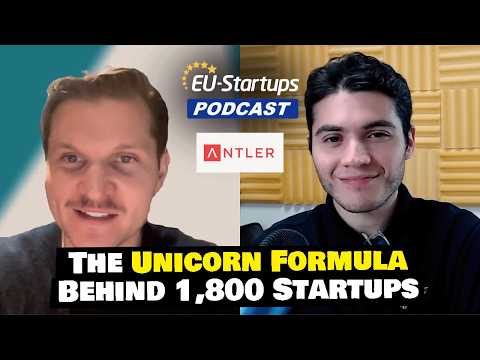
The Unicorn Formula Behind 1,800 Startups - Interview with Antler co-founder and CBO Fridtjof Berge
Full timeline
0.0–300.0
Antler is a venture capital firm that focuses on inception stage investing and has made over 1,800 investments globally. The firm aims to build relationships and add value to companies from an early stage, having started in Singapore in 2018 and now operating in 22 countries and 27 cities.
- Juff is the co-founder and CBO of the VC Antler
- Antler has invested in over 1,800 different investments
- Antler has backed unicorns such as lovablepeak.ai
- Antler started in Singapore in 2018
- Antler is active in 22 countries and 27 cities
- Antler focuses on inception stage investing
- Antlers strategy involves small check sizes initially
- Antler aims to build relationships and add value to companies from an early stage
300.0–600.0
Antler is involved in providing research on various aspects of startups, including founder demographics and funding trends. The speaker emphasizes the importance of ambitious target setting in the startup ecosystem, drawing from their extensive professional background.
- Antler provides valuable research on founders, funding, and gender ratios in startups
- The speaker has experience in McKinsey, Nordic Footwear, and a Met Tech startup
- The speaker is intellectually curious and enjoys managing multiple projects simultaneously
- Ambitious target setting is emphasized in the startup world, influenced by the speakers McKinsey background
- The speaker has lived in Singapore for nearly nine years and has a global background
- Founders across different ecosystems share similar characteristics despite facing different challenges
- Antler has deployed 5.4 million across 44 startups since 2019
600.0–900.0
The company has undergone three distinct phases of growth, starting with finding founders and making initial investments, followed by replicating successful strategies in new markets. The current phase focuses on external collaboration with governments and corporations to enhance support for entrepreneurs.
- The company has evolved through three distinct phases
- In the first year, the focus was on finding founders and making the first investments
- The second phase involved replicating proven strategies in other markets
- Adapting to local ecosystems required changes in language, marketing, and competitive environment
- The last phase has been more externally focused, collaborating with governments and corporations
- Projects include easier visa processes for entrepreneurs and volume discounts with cloud providers
- The CEO co-founder role has adapted as the company has grown and become more successful
900.0–1200.0
Founders are increasingly establishing companies in various locations, with Berlin currently experiencing significant startup activity. The number of cities with unicorns has surged from around 30 to over 300 in the past 12-13 years, driven by improved access to capital and talent.
- Founders are building union-grown companies out of more and more places
- Berlin is currently experiencing a lot of activity in the startup scene
- The number of cities with unicorns has increased from around 30 to over 300 in 12-13 years
- Access to capital and talent has improved, aided by the internet
- Founders now have more choices regarding where to build their companies
- Europe is sometimes compared unfavorably to China and the US in terms of success stories
- There are pros and cons to scaling and downscaling employment in different markets
- AI-driven startups can execute products and services in one location and distribute them globally
- The cost of starting companies is decreasing, allowing for higher valuations with less capital
1200.0–1500.0
Geopolitics plays a significant role in the operations of companies, particularly in local contexts, as trade deals and discussions become increasingly complex. The rapid increase in unicorn creation, from around four years a decade ago to nearly 150 today, highlights the potential for valuable innovations by capable teams.
- Geopolitics is important for companies, especially in local business contexts
- Antler is globally distributed and operates in many of the worlds biggest markets
- Trade deals and discussions between countries are complex and not black and white
- The cycles of change in technology and markets are becoming shorter
- Startups need to be adaptable and have multiple plans due to fast-changing environments
- Unicorn creation has increased significantly, from around four years a decade ago to nearly 150 today
- The rise in unicorns indicates the potential for valuable creations by smart teams
- Investors must be cautious about hype and rapidly increasing valuations
- Many current unicorns have true traction, including revenue and customers
1500.0–1800.0
The value of a billion-dollar company has decreased over the past 12 years, impacting perceptions of unicorn status. Younger founders, particularly in AI, are emerging with an average age of 21-29, while female unicorn founders have increased sixfold but still represent only six percent of all founders.
- A billion dollar company now is less valuable than 12 years ago
- AI unicorn founders seem to be getting younger, with an average age dropping to 21-29 in 2024
- Younger founders benefit from being comfortable with cutting edge technology and constant iteration
- Experience and good networks matter less in the current environment for AI founders
- Female unicorn founders have increased sixfold but still represent only six percent of all founders
- Entrepreneurship may become more accessible as barriers in cost and networks decrease
1800.0–2100.0
Founders can achieve more with fewer resources if they have a strong product market fit, but significant capital is still necessary for rapid scaling. Investors must consider how to provide value beyond just financial support to attract and retain talented founders.
- You can do a lot more with less
- Access to good advice and markets is easier with a good product market fit
- Raising considerable capital is still necessary for rapid scaling
- Founders need to overcome challenges regardless of product quality
- Building a global platform is important for founders seeking market access
- Investors need to think about adding value beyond just capital
- Promoting value in other ways is crucial to attract great founders